

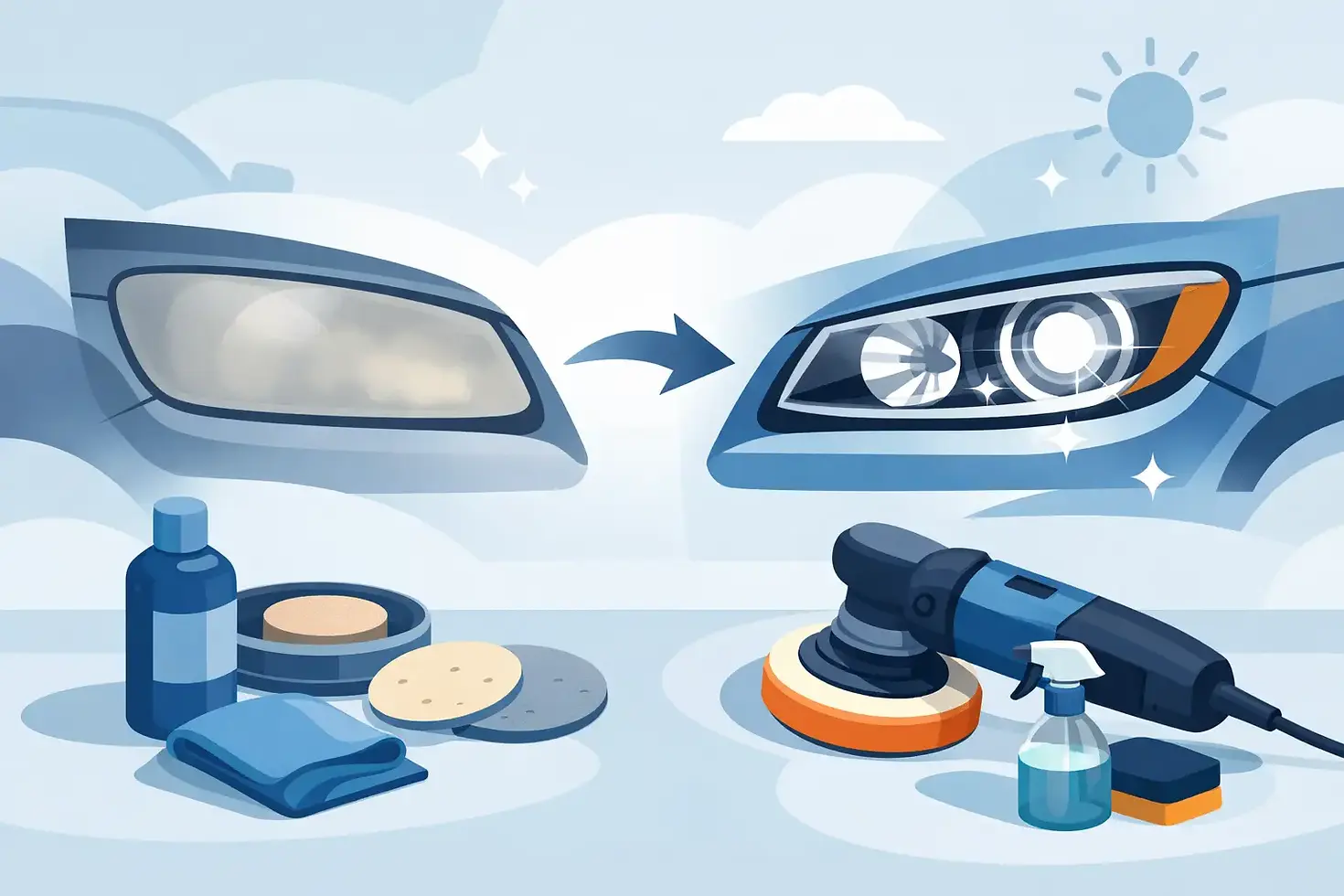
How to Restore Faded Headlights Properly

Cloudy headlights make even a well-kept car look tired. More importantly, they cut light output at the exact moment you need it most - on dark roads, in rain, and during those winter evenings when visibility drops fast. If you are wondering how to restore faded headlights, the good news is that the damage is often repairable. The less helpful truth is that not every method gives the same finish, and not every result lasts.
Why headlights fade in the first place
Most modern headlights are made from polycarbonate plastic rather than glass. It is strong, lightweight and practical, but it is also vulnerable. Over time, the factory-applied UV coating wears down. Once that protective layer starts to fail, sunlight, road grime, traffic film, salt and repeated washing begin to oxidise the surface.
That is what creates the dull, yellowed or milky look many drivers notice. Sometimes the damage sits right on the surface. Sometimes it has gone further, leaving pitting, deeper oxidation and a rough finish that catches light rather than projecting it cleanly down the road.
This is why headlights can look only slightly hazy in daylight but perform badly at night. The issue is not just appearance. It is clarity, safety and, in many cases, the overall presentation of the vehicle.
How to restore faded headlights at home
If the fading is light to moderate, a DIY approach can improve them. The key word is improve. Plenty of off-the-shelf kits can remove surface oxidation and bring back a clearer finish, but the result depends on the condition of the lenses and how carefully the work is done.
A proper home restoration usually involves cleaning the lens thoroughly, masking the surrounding paintwork, wet sanding through a few grades, polishing the plastic, and then applying a UV sealant or protective coating. Miss one of those stages, and the finish often falls short. Skip the protection stage, and the haze usually returns far sooner than expected.
To start, the headlights need to be fully cleaned and decontaminated. Any traffic film, wax residue or dirt left on the lens can interfere with sanding and polishing. Once clean, the surrounding trim and paint should be taped off carefully. This matters more than people think. A hurried sanding pass that catches painted panels can create a far bigger problem than the original haze.
Wet sanding is the stage that removes the failed top layer. Depending on the condition, this might begin with a more aggressive grit and then move progressively finer to refine the surface. The aim is not to grind away at the headlight until it looks clear. In fact, after sanding, it often looks more evenly dull. That is normal. The clarity comes back during polishing.
Machine polishing or hand polishing then works the surface back to transparency. This is where technique matters. Too little correction and the lens stays cloudy. Too much heat or pressure and you can create uneven areas, distortion or further damage. Once clarity is restored, a UV-resistant coating is essential. Without it, the newly exposed plastic is left vulnerable, and oxidation can return surprisingly quickly.
The biggest DIY mistakes
The most common mistake is using a quick-fix product that masks the problem rather than correcting it. Toothpaste, household abrasives and one-step miracle wipes might make the lens look better for a short while, but they rarely restore the surface properly. In some cases, they leave it patchy.
The second mistake is stopping after polishing. A polished headlight without UV protection may look bright for a few weeks, then begin to haze again. That can be frustrating, especially after the effort involved.
The third is misjudging the condition of the lens. If the headlight has deep oxidisation, internal staining, cracks or heavy pitting, a home kit may only deliver a partial improvement. It is not always about effort. Sometimes the material simply needs a more controlled correction process and better finishing products.
When professional headlight restoration is worth it
There is a point where convenience, finish and longevity matter more than saving a small amount on a kit. That is usually when the headlights are heavily faded, the vehicle is otherwise in good condition, or you want the job done properly first time.
Professional restoration is not just a faster version of DIY. It should involve a more measured process, better abrasives, refined polishing stages and durable protection designed to hold up against daily use. The difference is often obvious in both the immediate clarity and the way the headlights age afterwards.
For customers who care about the overall look of their car, this makes a real difference. Fresh headlights lift the front end of the vehicle straight away. They can make a car look newer, sharper and better cared for without any major cosmetic work. For anyone preparing a car for sale, tidying up faded lights can also improve first impressions far more than people expect.
There is also the practical side. Better light output means safer driving. If your headlights look dull, there is a fair chance the beam is not performing as it should. Restoring them is not just cosmetic enhancement. It is part of keeping the vehicle in proper condition.
What kind of result should you expect?
It depends on the starting point. Light oxidation can often be corrected to a near-like-new finish. Moderate fading usually responds very well too, provided the lens is restored and protected properly. Heavily neglected headlights can still improve dramatically, but perfection is not always realistic if the plastic is deeply pitted or has suffered internal damage.
A trustworthy detailer should be clear about that from the beginning. Not every lens can be made flawless, and promising otherwise helps no one. What matters is visible transformation, improved safety and a finish that holds up rather than fading back within a month or two.
This is where experience counts. Knowing how far to correct, how to preserve the lens, and which protection to apply is what separates a proper restoration from a short-lived tidy-up.
How long does headlight restoration last?
Again, it depends on the process and the aftercare. A rushed polish with no proper coating might last only a short period. A correctly restored and protected headlight should last significantly longer, especially if the vehicle is washed carefully and not left to bake in contamination.
Regular maintenance helps. Keeping the front end clean, removing insect residue promptly and using quality protection during exterior detailing can all support the finish. If the car spends most of its life outdoors, the headlights will naturally face more UV exposure, so durability becomes even more dependent on the protection applied after restoration.
Is replacement ever the better option?
Sometimes, yes. If the headlight is cracked, badly damaged internally, or the outer lens has deteriorated beyond sensible correction, replacement may be the better route. The same applies if moisture has entered the unit and the issue is no longer just on the outer surface.
That said, replacement units can be expensive, especially on newer or more premium vehicles. In many cases, restoration offers a far better return for the cost, giving a strong visual and functional improvement without the expense of new lights.
A practical approach for busy vehicle owners
For many people, the issue is not knowing that the headlights need attention. It is finding the time to sort them properly. That is where a mobile detailing service makes sense. Instead of buying products, setting aside half a day and hoping for the best, you can have the work carried out at your home or workplace with the right equipment and a results-focused process.
For drivers across Northamptonshire, Bedfordshire, Cambridgeshire and Milton Keynes, that convenience matters. A service like KJ Detailing brings the restoration to your doorstep, which means no workshop trips, no chasing products, and no compromise on finish.
Should you restore faded headlights now or wait?
If they are already looking cloudy, waiting rarely helps. Oxidation tends to get worse, not better, and the longer it sits, the more correction may be needed later. Acting early usually means a cleaner restoration, better end result and a stronger chance of preserving the lens in good condition.
If your headlights have lost their clarity, treat it as more than a cosmetic niggle. Restoring them can sharpen the whole look of the car, improve night-time visibility and protect the value of a vehicle you rely on every day. Done properly, it is one of those small jobs that makes the whole car feel better cared for.


Comments